
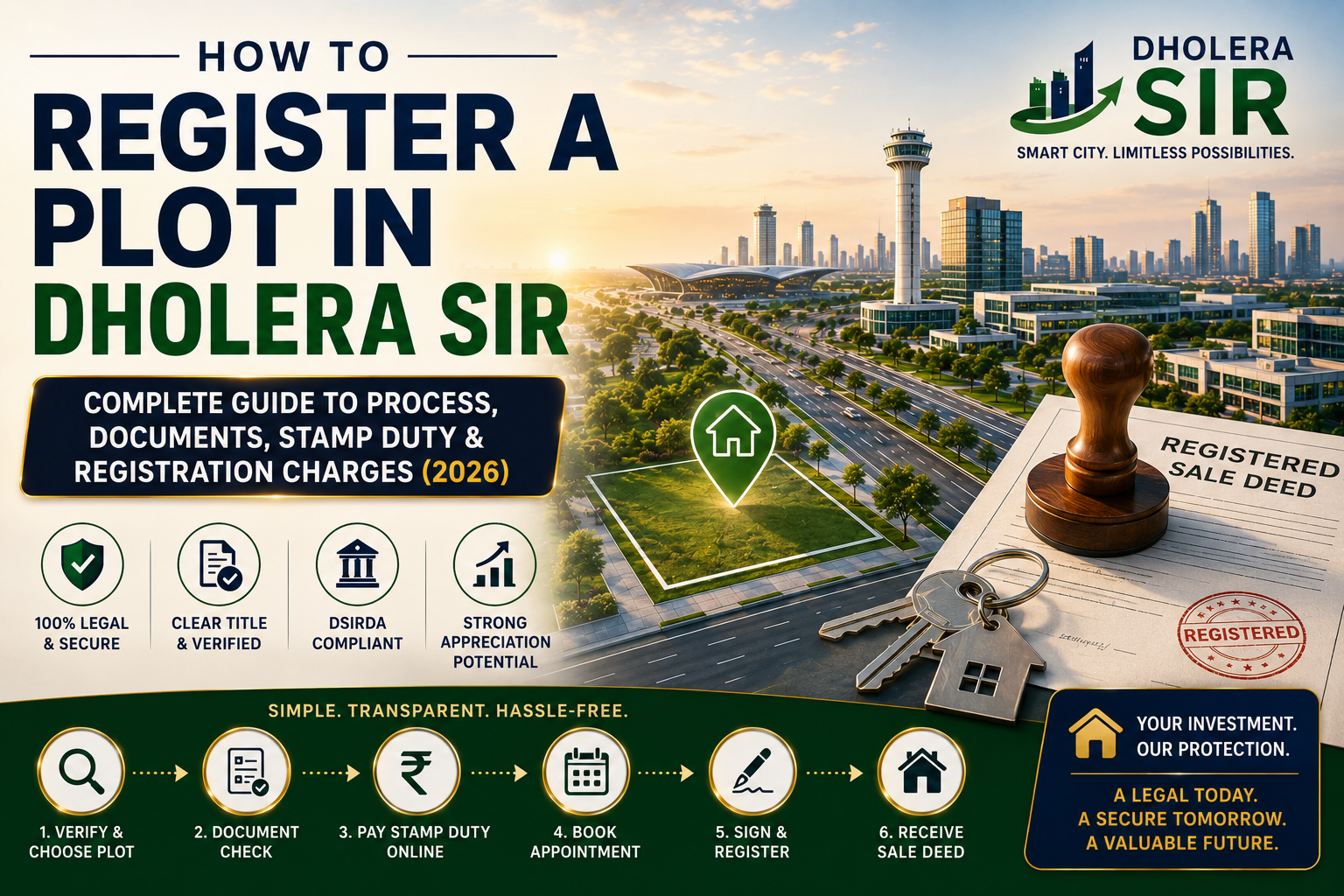
the full registration process (sale agreement through mutation), a stamp duty/registration fee table for Gujarat in 2026 (4.9% stamp duty + 1% registration fee, waived for sole female ownership)
Guide to Plot Registration in Dholera SIR
Once you've selected a plots in Dholera SIR and completed your due diligence, the next major step is registration — the legal process that formally transfers ownership into your name. This guide walks through the registration process step by step and breaks down the stamp duty and registration charges you should budget for in 2026.
Note: Stamp duty and registration rules are set by the Gujarat state government and can be revised. Always confirm current rates on the official GARVI portal or with your Sub-Registrar office before finalizing your budget.
Step-by-Step: The Plot Registration Process
- Sale Agreement — Once price and terms are finalized with the seller or developer, a sale agreement (agreement to sell) is drawn up, laying out the plot details, payment schedule, and conditions of sale.
- Document Verification — Before registration, verify the title deed, 7/12 extract, encumbrance certificate, and TP scheme / final plot (FP) number documentation to confirm clear ownership and compliance with the Dholera SIR master plan under DSIRDA.
- Jantri Rate Check — Confirm the Jantri rate (Gujarat's government-notified minimum valuation) for the plot's location, since stamp duty is calculated on whichever is higher: the Jantri rate or your actual transaction value.
- E-Stamping — Stamp duty is paid electronically through the Gujarat GARVI (Government Registration and Valuation Information) portal, generating an e-stamp certificate for the transaction.
- Book a Sub-Registrar Appointment — Registration is completed at the Sub-Registrar office having jurisdiction over the plot's location. Appointments can typically be booked online through the GARVI portal.
- Document Presentation & Biometric Verification — Both parties (buyer and seller) appear in person with original documents, ID proof, and photographs. Biometric verification (fingerprint/photo capture) is completed at the registrar's office.
- Execution of Sale Deed — The sale deed is signed by both parties in the presence of the registering officer and witnesses.
- Registration — The Sub-Registrar registers the document, and the buyer receives a registered sale deed — the primary legal proof of ownership.
- Mutation of Revenue Records — After registration, apply to update the local revenue records (mutation) to reflect the new owner's name. This step is essential for future resale, mortgage, or loan applications.
Stamp Duty & Registration Charges in Gujarat (2026)
Here's a breakdown of the current rates applicable to property transactions in Gujarat, including plots in Dholera SIR:
Charge Rate Applies To Basic stamp duty 3.5% All buyers Surcharge 1.4% All buyers Total stamp duty 4.9% All buyers Registration fee 1% Male buyers / joint ownership Registration fee Waived (0%) Sole female ownership
Illustrative example: On a plot valued at ₹40,00,000 (or its Jantri value, whichever is higher), stamp duty of 4.9% works out to ₹1,96,000, plus a registration fee of 1% (₹40,000) for a male buyer or joint ownership — bringing the total statutory charge to ₹2,36,000. If the plot is registered solely in a woman's name, the registration fee is waived, reducing the total to ₹1,96,000 (stamp duty only).
These figures are illustrative and based on rates reported as of mid-2026 — always verify the exact current rate on the GARVI portal, since state government rates are subject to revision.
Documents You'll Typically Need
- PAN card (mandatory for all property transactions)
- Aadhaar card or other government-issued photo ID
- Passport-size photographs of buyer and seller
- Sale agreement / agreement to sell
- Title deed and prior chain of ownership documents
- 7/12 extract and revenue record copies
- Encumbrance certificate
- TP scheme and FP number documentation
- E-stamp certificate (generated via GARVI after stamp duty payment)
A Note for NRI Buyers
If you're an NRI purchasing a plot in Dholera SIR, plan for a few additional steps: payments routed through NRE/NRO banking channels as per FEMA regulations, a Power of Attorney (POA) if you can't be physically present for registration, and PAN card documentation. Your consultant can help coordinate registration timing around your travel schedule, or manage the process under a properly executed POA.
Common Mistakes to Avoid
- Registering below the Jantri rate to save on stamp duty — this can trigger scrutiny and additional demand notices later.
- Skipping the encumbrance certificate check, which can leave hidden liabilities undiscovered.
- Delaying mutation after registration — this can complicate resale or loan applications down the line.
- Relying solely on the seller's documentation without independent verification.
Final Thoughts
Registration is the step that makes your plot purchase legally binding, and getting the process — and the associated stamp duty budget — right the first time saves considerable time and cost later. Working with a consultant familiar with DSIRDA's requirements and the local Sub-Registrar process can help the registration go smoothly.
Omana Projects assists buyers through the complete plot-buying and registration journey in Dholera SIR, with transparent guidance on documentation and current statutory charges.
Planning to register a plot in Dholera SIR? Contact Omana Projects for guidance through documentation, stamp duty, and the registration process.
Contact us here or directly call @ +91 92171 04219